Home


Weblog Archives

Gordy's Image Archive

Photography

Books & Movies

Bicycles

Family Stuff

Fibromyalgia


You can e-mail me at gcoale@
electricedge.com


www.flickr.com
Gordon Coale's items Go to Gordon Coale's photostream


One of the things that I do is make leather camera straps.


gordy's
camera straps


These are some of the blogs and other sources that are keeping me informed.

political blogs
'Just World News'
archy
Aron's Israel Peace Weblog
Bad Attitudes
Barbara's Blog
Clusterfuck Nation
Crooks and Liars

Conflicts Forum
Culture of Life News
Cursor
Daily KOS
Eschaton
Firedoglake
Foreign Policy Watch
Hullabaloo
Informed Comment
Joe Bageant
Magpie
Orcinus
Politics in the Zeros
Rootless Cosmopolitan
Sic Semper Tyrannis
Talking Points Memo
The Agonist
The News Blog
The Peking Duck
The Washington Note
This Modern World
Tom Dispatch
Unclaimed Territory
Under News
War and Piece

political magazines
AlterNet

Antiwar.com
CommonDreams
Council on Foreign Relations
CounterPunch
Democracy Now!
Information Clearing House
Salon
truthout
The Huffington Post
The Nation
The NY Review of Books
truthdig
Working for change
Znet

photographer blogs
2point8
A Botzilla Journal
alec soth
Amy.Elkins.Photo
Batteries Not Included
Conscientious
consumptive
Daily Walks
decoys like curves
dispatches
Frank Petronio
Ghosts of Krasnogorsk
Greyhoundman's Ramblings
Heading East
hmmn
Joe Reifer - Words
joe's nyc
m e g a p e r l s
Musings on Photography
NewFacts
Night Photography
Not If But When #2
Orbit 1
panoramas.dk

Photoethnography
photostream
Richard Vaneck
Shards of Photography
Single Coated
Speak, See, Remember
Streetzen
The Landscapist
The Nocturnes Night Photography Blog
The Online Photographer
The Price of Silver
Therefore, I_blog
Travis ruse
Water Molotov
While Seated
Working Pictures
Xtoid
Zoe Strauss

on photography
AjaxNetPhoto.com
AK47.tv
circle of confusion
Photo Business News & Forum
photo-i
f295
File
APUG
iN-PUBLiC
Large Format Photography Forum
making room
PhotoReporter
photo.net
Polar Inertia Journal
Rangefinder Forum
seesaw
Streetphoto
Strobist
The Digital Journalist
The Luminous Landscape
vrmag
zone|zero

on art
Art & Perception

visual delights and amusing curiosities
Coudal Partners
Everlasting Blört
eyeLevel
Eye of the Goof
J-Walk Blog
Giornale Nuovo
gmtPlus9 (-15)
Marja-Leena Rathje
Neatorama
plep
ping
Riley Dog

The Cartoonist
Wooster Collective

pencils and notebooks
Pencil Revolution
moleskinerie
Timberlines
Ninth Wave Designs
Pencil World Creativity Store

life
by Neddie Jingo!
Pure Land Mountain
YBLOG ZA

aging
Time Goes By

books
Broken Books

multifaceted
(Notes on) Politics, Theory & Photography
all noise - all the time
dangerousemeta!
dumb monkey
reading & writing
Spitting Image
wood s lot

science
Pharyngula
The Loom

sustainability
WorldChanging

iraq
A Family in Baghdad
Baghdad Burning
Iraq Slogger
Iraq Veterans Against The War

iran
View From Iran

palestine
From Gaza, with Love
Raising Yousuf, Unplugged
Occupation Magazine

israel
MuzzleWatch

oil/energy
321 energy
The Mike Runge Peak Oil Archive
The Oil Drum

local news (seattle)
Seattle Independent Media Center
Seattle PI
Seattle Times

national news
Drudge Report
Independent Media Center
LA Times
NY Times
MSNBC
SF Gate
Washington Post
Village Voice

international news
uk
BBC News
Guardian - World News
Independent
israel
Ha'aretz
Jerusalem Post
palestine
Electronic Intifada
Palestine Chronicle
Ramallah Online
egypt
Al-Ahram
asia
Asian Times

comics
Doonesbury


A Great
American Patriot


A website I'm doing on my grandfather's experiences during WW II as a Navy Combat artist:
Griff's Story


Free books!

Or you can go to:
The Online Books Page

It's database includes Project Gutenberg, as well as many others.


I've created a Frapper map for this blog.You can add your name and location on a map (they just need a name and zip.) Put yourself on the map and let me know where you are.


Zoe found this one too:

Locations of visitors to this page
See where my readers come from.


I also design websites:
ElectricEdge
web solutions


If anyone has a burning desire to buy me a book or a CD then check out my
Amazon Wish List


Peace, love,
and groovy colors.


Powered By Greymatter

 
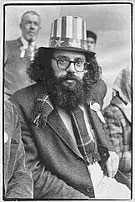
atributed to Elliot Erwitt
 

  Tuesday   October 14   2008

here comes the sun

Here are some great sun pictures. Looks kind of hostile.

The Sun


[more]

  thanks to Huffington Post


 09:13 AM - link


economy

It's certainly been all economy all the time around here lately. I know I have some other links around here somewhere. It's just that everything else pales by comparison. Hopefully, these will be the last economy links for the week. Unless, of course, more shit hits the fan.

When $700 Billion is Chump Change


"Once a run gets started it is rational for other people to join in."
- Mervyn King, Governor of the Bank of England, commenting on bank runs

Probably about now the people who actually wanted the massive bailout of the Wall Street crooks are asking themselves, "What exactly did we buy with the $700 Billion in taxpayer money?" It's a little late to ask that question You don't purchase a car without kicking the tires, you don't purchase a home without having the foundation inspected, and you don't bail out Wall Street unless you made certain that the money isn't going to be wasted.

With the DOW dropping nearly 2,300 points in just the 7 days since the bailout was announced, the sheeple are realizing that they've been mugged by the crooks yet again. Except this time the taxpayer wasn't held up. We gave them our wallets willingly.

Now here's the kicker: That $700 Billion is only the downpayment. The real payments are already happening and Congress didn't vote on it.

How much is this going to cost all of us? More than you can possibly imagine.

The global financial crisis is turning into a bigger drain on the U.S. federal budget than experts estimated two weeks ago, ballooning the deficit toward $2 trillion.
Bailouts of American International Group, Fannie Mae and Freddie Mac likely will be more expensive than expected. States are turning to Washington for fiscal help. The Federal Reserve said this week it will begin buying commercial paper, the short- term loans companies used to conduct day-to-day business, further increasing costs. And analysts now say the $700 billion bank- rescue plan passed by Congress last week may have to be significantly larger.

Can you even imagine a $2 Trillion yearly deficit? To put this into perspective, this country has accumulated just over a $10 Trillion in 230 years. Now we'll be adding 20% to that in a single year, and then do it again next year. Where is all that money going to come from in a country with no savings?


[more]


Global Economic Crisis Likely To Have Profound Consequences For US Politics, World Relations


The global economic crisis is likely to have profound, long-range consequences for American politics and for the relations of the United States with the rest of the world, severely constraining any effort to maintain or revive the Bush administration's propensity for unilateralism, and posing a broad international challenge to free market ideologies, according to a range of experts.

The scope of these changes remains uncertain, and all those who responded to October 11 and 12 inquiries from the Huffington Post warned that predictions in these circumstances are perilous. But there is a strong consensus that it would be a mistake to minimize the coming upheavals.

In the United States, economic developments have the potential to lay the groundwork for a political transformation with major alterations in both the composition of, and balance of power between, the major political parties. There are "reasons for thinking that the American election of 2008 may be the equivalent of the election of 1932 - an electoral sea change ushering in a new wave of government intervention and, if that intervention is successful, a durable electoral realignment," says Peter Hall, Krupp Foundation Professor of European Studies at Harvard, in a wide-ranging analysis he provided to the Huffington Post, available in full at the end of this article.

[more]


It's Wall Street's Turn to Bolster Confidence


In putting several trillion dollars in government funds on the line, the country has now done just about everything that Wall Street could have asked to address the financial crisis. The question now, as John Kennedy might have put it, is what Wall Street is ready to do for its country. So far, the answer is not much.

After getting their closed-door briefing yesterday from Paulson on the government's latest initiatives, Wall Street's finest literally ran from the Treasury to their waiting limousines, bypassing a media scrum eager to convey any scrap of wisdom or insight.

Court reporters will tell you they can always tell the innocent from the guilty on these kinds of perp walks, and the Wall Street crowd yesterday looked particularly guilty, unable even to conjure up a soothing word to a nation fretting over its shrunken 401(k)s, or a simple thank you to taxpayers for having saved their bacon. Their silence and invisibility throughout this crisis attests to the moral and political bankruptcy of a financial elite that is the perfect match for the financial bankruptcy they have now visited upon their investors, their creditors and their customers.

After yesterday's "historic" meeting, we are told by industry apologists that we are supposed to be grateful to nine leading banks for having "volunteered" to accept additional capital from the Treasury, along with a government guarantee for newly issued bank debt, even if it means having to accept a dilution of existing shares and a few harmless restrictions on their operations.

Pardon me if I'm less than blown over by this munificent offer, but it hardly seems commensurate either with the severity of the current crisis or the depth of the banks' culpability in fomenting it.

If Wall Street were truly serious about convincing Main Street that we're all in this together, its top executives would have stepped before the cameras yesterday and promised not to cut lines of credits to long-standing business customers who have never missed a payment.

They would have committed themselves not to foreclose on any homeowner who is willing and able to refinance into a new, government-guaranteed, fixed-rate mortgage set at 85 percent of the current value of the property.

They would have offered to suspend dividend payments until capital levels had been restored to pre-crisis levels.

They would have given us their solemn promise not to advise clients to hold on to their own investments while quietly dumping whatever they can from their own portfolios and shorting every security in sight.

With the Treasury now desperate for help in managing its new rescue efforts, they would have volunteered, at no cost to taxpayers, the services of some of those investment bankers and financial wizards who now don't have much else to do.

And the maharajas of finance could have set a wonderful example if they had all gotten together and agreed to work for a dollar a year until the crisis has passed.

[more]

  thanks to Talking Points Memo


But the maharajas of finance will do no such things. Instead they will be back to their old tricks of scam and fraud that got us into this mess.


Banktron


[more]


 08:53 AM - link


  Monday   October 13   2008

economy

Fed Announces Unlimited Borrowing


[more]


Economic Globlization and Speculation Coming Home to Roost


With the current economic crisis which seems to be spreading across the world we are dealing with far more than a “subprime” crisis, or an attempt to “quarantine “toxic debt.” There is a much bigger avalanche waiting to come tumbling down. Namely the derivatives market now estimated to be over $1 quadrillion (that is 1,000 trillion) in global derivatives holdings. That makes the current $700 billion bailout look like less than a drop in a very large bucket.

As the long predicted crash started unfolding, I have been nagged by a long sequence of events that seem to be culminating at the current moment. There have been significant structural changes in the U.S. and elsewhere that have impacted both labor markets, and capital. In terms of labor markets (also known as workers) the transitions have been stark. In the United States we have watched the long term decimation of the manufacturing sector and a transition to a “service” economy. I remember the concerns in the 1980’s about the transformation of the U.S. economy from a production economy to a consumer economy. This trend was accelerated with broad implementation of corporate-driven globalization and formalized by the passage of NAFTA (North American Free Trade Act) and the rewriting of GATT (General Agreement on Tariffs and Trade).

These two international trade agreements were structured along similar philosophies. Namely the removing of “boundaries” to trade, and enhancing the “boundaries” around workforces. Those boundaries were national boundaries and national sovereignty. We saw the exportation of U.S. job (outsourcing and off-shoring) accelerate. We also started seeing the merger mania of the 1980s which have continued to the present. In fact, they are a prominent feature of the current crisis.

Other nations, in a competitive and revolving fashion, became the cheap, exploitable labor force for a global economy. China, maximizing on its single most abundant resource (people) successfully positioned itself as the cheap workforce for global corporations searching to always maximize profit. (Now they too import even cheaper labor).

All along this path towards removal of boundaries, there has been increasing financial and investment penetration in an increasingly intertwined global financial market.

[more]

  thanks to Culture of Life News


The Nausea Express
by Jim Kunstler


The G-7 world, the club of "developed" western nations plus Japan, has commenced an ordeal of suddenly waking up much poorer. All the desperate work-arounds being engineered by governments and central banks on an al fresco basis are intended to overcome this stunning basic fact, and none of them will. The benchmarks of everything are in flux -- stocks, bond values and yields, commodity prices, most especially currencies -- but these tend to disguise the basic fact of growing and spreading impoverishment. Is oil priced at $80 a barrel this morning? That's nice. Except if the company that employs you is about to fold up and you face a holiday season of driving frantically around Atlanta in search of another job, which the odds are against you find finding. Or if you're living on a retirement fund that's just lost 37 percent of its value and it's time to fill the heating oil tank.

Iceland is the poster-child du jour for this. The little island nation of about 320,000 souls (roughly half of Vermont's population) lately grew a banking sector that thrived on something-for-nothing finance. In little more than a month, its banks have imploded like mini death stars, leaving Iceland with a pariah currency. Since it has to import just about everything, and it suddenly finds itself unable to pay for imports, the people are stripping the grocery markets of whatever remains there now. You wonder what they will do in two weeks. Ten years from now there may be 32,000 of them left, subsisting on blubber sandwiches.

I exaggerate perhaps a little, but who really knows where all this leads? Here in the USA, the Treasury, enjoying new and seemingly limitless powers of discretionary spending, has begun shoveling dollars into every truck that backs up to the loading dock. The numbers are staggering. In ten days it's reached into the trillions in loans and handouts. Most of this money is getting sucked directly into the black hole of debt and margin calls of one kind or another. This is previously-presumed wealth that is now un-presumed. It's leaving the system, never to be seen again. One useful way of thinking about it is to regard it as our society's previous borrowings against our own future. Thus, we are seeing our future vanish into a black hole -- our future comfort, health, and basic nourishment.

[more]


Rescue for the Few, Debt Slavery for the Many
Congress Should Bail Out of the Bailout


We are now entering the financial End Time. Bailout “Plan A” (buy the junk mortgages) has failed, “Plan B” (buy ersatz stocks in the banks to recapitalize them without wiping out current mismanagers) is fizzling, and the debts still can’t be paid. That is the reality Wall Street avoids confronting. “First they ignore you, then they denounce you, and then they say that they knew what you were saying all the time,” said Gandhi. The same might be said of today’s overhang of debts in excess of the economy’s ability to pay. First the policy makers pretend that they can be paid, then they denounce the pessimists as spreading panic, and then they say that of course students have been taught for four thousand years now how the “magic of compound interest” keeps on doubling and redoubling debts faster than the economy can squeeze out an economic surplus to pay.

What has ended is the idea that “the magic of compound interest” can make economies rich without having to work and without industry. I hope we have seen the end of derivatives formulae seeking to make money by playing in a zero-sum game. A debt overhang always ends either in foreclosure of the debtor’s property, or in a debt annulment to preserve the economy’s overall freedom and equity.

This means that the postmodern economy as we know it must end – either in financial polarization and debt peonage to a new oligarchic elite, or in a debt cancellation, a Jubilee Year to rescue society. But when the government says that it is reviewing “all” the options, this reality is not one of them. Treasury Secretary Henry Paulson’s first option was to buy packages of junk mortgages (collateralized debt obligations, CDOs) to save the wealthiest institutional investors from having to take a loss on their bad bets. When this was not enough, he came up with “Plan B,” to give money to banks. But whereas Britain and European countries talked of nationalizing banks or at least taking a controlling interest, Mr. Paulson gave in to his Wall Street cronies and promised that the government’s stock purchases would not be real. There would be no dilution of existing shareholders, and the government’s investment would be non-voting. To cap the giveaway to his cronies, Mr. Paulson even agreed not to ask executives to give up their golden parachutes, exorbitant annual bonuses or salaries.

[more]


The Bailout in Plain English
Speaking in the Tongues of Brokers


Any number of cultural historians have noted the American belief that success is a sign of God's favor. And over the past couple of decades he has had a downright love fest with the already-rich. So much so that the richest 400 Americans now have more money stashed away that the combined bottom 150 million Americans. Some $1.6 trillion bucks.

This was accomplished by selling off or shipping out ever available asset, from jobs to seaports, smashing usury and anti-monopoly laws, raiding the public coffers and manipulating the medium of exchange and blackmailing the peasantry regarding common needs such as heath care and energy to keep their asses warm -- to name a few. The ultimate coup was to convince the entire nation that the well being of the rich, meaning the well being of Wall Street, was indeed the common man's well being.

All went well for a while. People went into credit card hock up to their noses in order to provide 26% credit card interest to Wall Street, etc. And when that became untenable, flimsy mortgages were cranked out by the millions ensuring that every American who could hold a crayon could sign to purchase a home. To facilitate this all sorts of shaky 'mortgage instruments' were created -- balloon, (sign here Jeeter, you're gonna flip it in a year and make a hundred K on this house trailer) interest only, and finally negative balance mortgages where you only paid part of the interest and the rest was rolled back into the principal balance. And joy of joys you could refinance a couple of times while the inflated value of these houses was on the way up. Life was good for everybody.

The bill was never gonna come due because, god in his wisdom, had deemed that capitalism would defy the second law of thermodynamics and expand forever. So every time a bank made a mortgage loan of say, $400,000, even though the debtor had never even made a payment yet, the loan was declared a bank asset and another $400,000 was loaned against it. Meanwhile, the Federal Reserve Bank yelled whoopee and printed another $800,000 in currency. Of course at some point the country had to run out of customers, so the loans got easier and easier. No matter that debt is not wealth. Wink and call it that and most folks won't even look up from their new big screen high resolution digital TVs.

Problem was that all the jobs to pay for this stuff were stampeding off toward places in China with names containing a lot Xs, Zs and praying for a vowel. It was becoming clear that the entire economy was running on fumes. In fact less than fumes. It was running on the odor of paper. Mountains of the stuff. Bundles of mortgages and very strange securities and derivatives of unknown origin and value. Paper that stated its own worth and signed by some mystic hand no one could quite identify though the blurry signatures looked to read Greenspan, Paulson and Bernanke.

But there was a rub. Things reached the point where there simply was not anything left to defraud the public out of, nothing left to steal from the nation's productive capability, no matter how much paper Jeeter and Maggie signed for that trailer house, no matter how secure Brian and Jennifer out there in Arlington, Virginia and Davis, California thought they were. So the only thing left to do was steal from future generations of Americans and accept an I.O.U. which the government would happily sign on behalf of the people and enforce. By the wildest coincidence, under the Bush administration this I.O.U. happened to tally up to about $700 billion.

[more]


The Grapes of Wrath, 2008: How will our generation handle a Great Depression?


[more]

 12:56 PM - link


  Thursday   October 9   2008

economy

Very busy but I couldn't resist this.

David Horsy


[more]

 10:04 AM - link


  Monday   October 6   2008

economy

I've only put up links on the economy this past couple of weeks because there is nothing happening that is more important. I've seen a lot of history in my life (64 years of it) but nothing as big as this. The collapse has spread to Europe. The Dow is under $10,000. The shit is hitting the fan. And our fearful leaders have no fucking clue. It should be an interesting week.

All Fall Down
by Jim Kunstler


God knows what manner of deals went down this past weekend in the Hamptons wine cellars and below-decks among the Chesapeake Bay sailboat fleet. All these hidey-holes must have been dank and fetid with the sweat of mortal fear. Will the US Government declare itself a subsidiary of General Electric? Will Vlad Putin be roped in to save Goldman Sachs? Meanwhile, the whole noisome rat maze of international counter-party deals was taking on sewer water and rodents of every nationality were seen leaping for daylight all over the fusty old motherlands of Europe. A cascading collapse of international finance is underway. While many fixers may jump heroically into the tumbling wreckage hoping to rescue this-and-that, the outcome by Friday is liable to be an unrecognizable smoldering landscape of the G-7's hopes and dreams.

Some big questions for the week: will the Euro survive as a currency? Will the rush into the US dollar continue even as the US financial system dematerializes in a Fibonacci fever of accelerating de-leveraged infinitude? Will the remaining Big Boyz, Goldman Sachs and JP Morgan succumb to the counter-party hemorrhagic fever? Will great rows of lesser banking dominoes now start clacking onto their faces? Will all fifty states follow the leads of California and Massachusetts and line up at the US Treasury's hand-out window. Will the entity that calls itself the civilized world be left at week's end with anything resembling money?

Your guess is as good as mine. We've entered the realm of phase change, where everything is slipping and nothing has settled. The final result, when the dust settles -- and that may not be for weeks to come -- will certainly be a poorer western world. Will it be so poor that it can no longer afford to import anything? Including oil from the land of the date palm? If so, we are really in for a rough ride, poised as we are at the edge of the heating season here in the temperate regions. Notice, by the way, that the $700 billion just approved by congress to bail out Wall Street is exactly the same sum of money that we send to the oil exporting nations this year.

[more]


Economic Consequences of the Bailout Plan


I'm not going to go through this in detail, but just quickly hit the highlights then discuss what this will mean for ordinary people and the economy.

Fundamentally it's the Treasury Secretary to spend pretty much as he chooses, with meaningless oversight, up to 700 billion or the debt limit. In theory it's "whichever is less" in practice it's going to be "whichever is more". Add to this the end of mark to the end of mark to market, and the move to mark to "whatever the bank says its worth" and banks are going to be allowed to stay alive no matter whether they're solvent or not as long as their cash flow doesn't go so far negative it can't be papered over the world's favorite wallpaper, the US buck. Zombie banks plus all the money flooding into trying to stop deleveraging from wiping out said financial institutions means this is a Japanification plan.

Japan had its own bubble back in the 80's. When it popped the Japanese decide that they would not force banks to write down their losses. Instead they left them on the books. Those of you who are old enough will remember when Japan was the economy of the future, who built the best stuff and were destroying everyone else. After the bubble popped that all ended. The world's most vibrant economy went into a long economic slump from which it never recovered. This wasn't a classic depression—there wasn't a huge immediate contraction. Things just generally got lousy - unemployment rose somewhat, jobs stagnated, no one had a lot of money. The good times never, ever, came back ever again. It was like being caught in a low grade recession, all the time.
[...]

And there are some ways this could be fixed. A lot of economists, like Stiglitz, are betting that Obama will eventually do a real bailout bill. We'll see. He made no real push to fix this bill at all that I am aware of and his various economic policies have long indicated to me that he is essentially a gentler kinder Reaganite in economic terms, so I'm not so sure. Still, there are solutions, and I'll talk about some of them in future, as I have in the past. The question is whether there will be any political will to do them. When you can pass a 700 billion bailout for the rich, but putting in real changes in bankruptcy laws to allow folks to keep their houses is unthinkable, it's clear that the elite consensus is still that the little people are always to be made to pay to clean up their betters mistakes. Until that attitude changes, very little useful is likely to get through Congress.

Everyone will be very interested in this again soon enough. In the meantime I wish you all, my readers, the best of luck and good health. I will repeat my standard advice that the most important thing in an economic downturn, by far, is not so much which securities your money is in, but how good your relationship is with your family, friends, neighbors, and most especially, your spouse.

[more]


“That Future You Sold?” said the Devil, “I’m here to collect”


For years people like me have been saying "this can't go on forever" and for years people have been ignoring us. "Hey, why can't we live beyond our means forever? The credit card nations will never cut us off."

You're cut off. You owe more than you can pay. The 700 billion+ bill was just the first attempt by your creditors to get some money out of you. As I've noted before, it's not an accident that that foreign banks can sell their crap to you at above market prices. That's because you sold them that crap and they want to recoup some of their losses.

It's not an accident that China (your number one creditor) told its banks to stop lending to American banks. China wants some of its money back. It knows it isn't going to get most of it back, but what it can get back, it will.

There ain't no such thing as a free lunch. Now is when the US pays for all those years of selling paper and the future for real stuff now. The US figured it'd pay later.

Later is now.

The future is here.

And the Devil wants what you promised him.

Your future.

[more]


Edge of the Abyss
by Paul Krugman


As recently as three weeks ago it was still possible to argue that the state of the U.S. economy, while clearly not good, wasn’t disastrous — that the financial system, while under stress, wasn’t in full meltdown and that Wall Street’s troubles weren’t having that much impact on Main Street.

But that was then.

The financial and economic news since the middle of last month has been really, really bad. And what’s truly scary is that we’re entering a period of severe crisis with weak, confused leadership.

The wave of bad news began on Sept. 14. Henry Paulson, the Treasury secretary, thought he could get away with letting Lehman Brothers, the investment bank, fail; he was wrong. The plight of investors trapped by Lehman’s collapse — as an article in The Times put it, Lehman became “the Roach Motel of Wall Street: They checked in, but they can’t check out” — created panic in the financial markets, which has only grown worse as the days go by. Indicators of financial stress have soared to the equivalent of a 107-degree fever, and large parts of the financial system have simply shut down.

There’s growing evidence that the financial crunch is spreading to Main Street, with small businesses having trouble raising money and seeing their credit lines cut. And leading indicators for both employment and industrial production have turned sharply worse, suggesting that even before Lehman’s fall, the economy, which has been sagging since last year, was falling off a cliff.

[more]


Still on the Edge of the Abyss


Years from today, when the current financial crisis is over, historians are likely to agree that it would have been far better if the Bush administration had declared a state of emergency earlier in the process so that the necessary steps could have taken to avoid a complete financial meltdown. The media could have been used to bring the American people up to date on market-related developments and educated in the bizarre language of structured finance. Knowledge is power; and power can prevent panic.

Now we're in a terrible fix. People are scared and removing their money from the banks and money markets. This is intensifying the freeze in the credit markets and driving stocks into the ground like a tent stake. Meanwhile, our leaders are caught in the headlights, still believing they can finesse their way through the biggest economic cataclysm since the Great Depression.

If something is not done to increase the flow of credit immediately, the stock market will tumble, unemployment will spike, and many businesses will grind to a standstill. We could be just days away from a severe shock to the system. Secretary of the Treasury Henry Paulson's $700 billion bailout does not focus on the fundamental problems and is likely to fail. At best, it puts off the day of reckoning for a few weeks or months. Contingency plans should be put in place so the country does not have to undergo post-Katrina bedlam.

Does Congress have any idea of the mess they've made by passing the Bailout bill? Did any Senator or congressperson voting Yes even notice, that while they were busy mortgaging off America's future, the stock market was plummeting to new lows? Between the time the ballots were cast on Paulson's bailout, and the announcement of the final tally (which was approved by a generous margin) the market went from a 310 point gain to a 157 point loss; a 467 point plunge in less than two hours.

Thus spake the Market: "Paulson's bill is a fraud!"

[more]


Get Your Dollars Out Now! FAST!!!


The events of the last two weeks have clearly revealed that the global financial, monetary and banking system imposed on the world by the power structures promoting "globalization" is fundamentally flawed, unviable and immoral in its effects upon the most all of Mankind. After allowing a small cabal of shady characters to illegitimately accumulate vast amounts of wealth and power over markets, corporations, industries, media, armed forces and entire nations, like the World Trade Center towers on 9/11, this entire System is now in free-fall, collapsing into itself in one massive implosion.

This loathsome and unjust Global Power System was designed and implemented over the past seven decades by the geopolitical and geoeconomic strategic planners serving the New World Order power structures, most notably its network of discrete, low-profile but highly powerful private think tanks, such as the Council on Foreign Relations (CFR, founded in New York in 1919), The Trilateral Commission (founded in 1973), The Bilderberg Conference (formed in Holland in 1954), and others like the Cato Institute, American Enterprise Institute (AEI), and the notorious Neo-con Project for a New American Century (PNAC) (1).

Considering the enormous complexity of the process that is taking place right now; the vast amounts of information we are bombarded with every minute of the day, and the apparent difficulty in foreseeing just how this global crisis will finally be resolved, we would summarize certain important aspects and key data which we believe will help us put together this veritable jig-saw puzzle, so that we may begin to fathom what the true face of this horrendous creature euphemistically called "globalization", is really like. As Argentine citizens, we have a huge advantage over other peoples including US citizens when it comes to understanding and coping with this kind of crisis. I say this because in our own lifetimes we have suffered in Argentina all of what is now happening globally - albeit on a much smaller scale in our case. We've seen this movie... We've been there, and done that... We've been pushed and dragged through the entire hysterical hocus-pocus of inflation, hyperinflation, systemic banking collapses, currency changes, Debt Bond Swaps, Mega-Debt Bond Swaps, financial "armouring", banking holidays, freezing of bank accounts, etc., etc... And we have also suffered the end-results: bank bail-outs paid for by taxpayers (or through inflation, or through the confiscation of savings), disappearance of pension funds, destruction of job posts and overall impoverishment of the population.

Considering the enormous complexity of the process that is taking place right now; the vast amounts of information we are bombarded with every minute of the day, and the apparent difficulty in foreseeing just how this global crisis will finally be resolved, we would summarize certain important aspects and key data which we believe will help us put together this veritable jig-saw puzzle, so that we may begin to fathom what the true face of this horrendous creature euphemistically called "globalization", is really like. As Argentine citizens, we have a huge advantage over other peoples including US citizens when it comes to understanding and coping with this kind of crisis. I say this because in our own lifetimes we have suffered in Argentina all of what is now happening globally - albeit on a much smaller scale in our case. We've seen this movie... We've been there, and done that... We've been pushed and dragged through the entire hysterical hocus-pocus of inflation, hyperinflation, systemic banking collapses, currency changes, Debt Bond Swaps, Mega-Debt Bond Swaps, financial "armouring", banking holidays, freezing of bank accounts, etc., etc... And we have also suffered the end-results: bank bail-outs paid for by taxpayers (or through inflation, or through the confiscation of savings), disappearance of pension funds, destruction of job posts and overall impoverishment of the population.

[more]

 10:56 AM - link


  Wednesday   October 1   2008

america the tarnished

My absence from this page has been due to being overly busy. Busy on the homefront. Very busy with work. Part of that is with a photography project I've started that finally got me to do some upgrades to my Epson V700 scanner that will make a big difference. I will report on them. Then I've also been busy watching the undoing of America. Big History is happening in front of us. Pay attention. Things will be very different when the dust settles. And, whatever happens, it won't be a pretty sight. A German perspective from Spiegel Online:

America Loses Its Dominant Economic Role
The banking crisis is upending American dominance of the financial markets and world politics. The industrialized countries are sliding into recession, the era of turbo-capitalism is coming to an end and US military might is ebbing. Still, this is no time to gloat.


There are days when all it takes is a single speech to illustrate the decline of a world power. A face can speak volumes, as can the speaker's tone of voice, the speech itself or the audience's reaction. Kings and queens have clung to the past before and humiliated themselves in public, but this time it was merely a United States president.

Or what is left of him.

George W. Bush has grown old, erratic and rosy in the eight years of his presidency. Little remains of his combativeness or his enthusiasm for physical fitness. On this sunny Tuesday morning in New York, even his hair seemed messy and unkempt, his blue suit a little baggy around the shoulders, as Bush stepped onto the stage, for the eighth time, at the United Nations General Assembly.

He talked about terrorism and terrorist regimes, and about governments that allegedly support terror. He failed to notice that the delegates sitting in front of and below him were shaking their heads, smiling and whispering, or if he did notice, he was no longer capable of reacting. The US president gave a speech similar to the ones he gave in 2004 and 2007, mentioning the word "terror" 32 times in 22 minutes. At the 63rd General Assembly of the United Nations, George W. Bush was the only one still talking about terror and not about the topic that currently has the rest of the world's attention.

"Absurd, absurd, absurd," said one German diplomat. A French woman called him "yesterday's man" over coffee on the East River. There is another way to put it, too: Bush was a laughing stock in the gray corridors of the UN.

The American president has always had enemies in these hallways and offices at the UN building on First Avenue in Manhattan. The Iranians and Syrians despise the eternal American-Israeli coalition, while many others are tired of Bush's Americans telling the world about the blessings of deregulated markets and establishing rules "that only apply to others," says the diplomat from Berlin.

But the ridicule was a new thing. It marked the end of respect.

[more]

  thanks to 'Just World News' with Helena Cobban


Hopefully, regular programming will resume soon.

 10:57 AM - link


  Monday   September 22   2008

economy

Our economy, like our situation in Iraq, presents no good solutions. The solutions to our impending economic meltdown, being presented by the Bush administration, are to help the rich and to screw everyone else, just like all of the Bush administration's solutions. This is the biggest grab of all. They are running out of time. Just a few months before a new administration takes over and they still have a lot of looting left to do.

Falling Into Fall
by Jim Kunstler


So many shoes are poised to drop this week that the American scene might be confused for the world's greatest-ever clog dancing festival, but a closer look will reveal a circle of cavorting skeletons.

Last week's ripe moment turned out to be the Thursday night Washington photo op when Treasury Secretary Paulson and Fed Chief Bernanke emerged from a huddle with House Speaker Nancy Pelosi and just about every other legislative eminentissimo in an attempt to reassure the nation that its financial system had not turned into something like unto a truckload of stinking dead carp. I don't know about you, but I got two distinct vibes from the faces in that particular tableau: 1.) abject fear, and 2.) a total lack of conviction that they knew what they were doing.

The product of that huddle was a cockamamie scheme for the US treasury to absorb all the losses from a twenty-year binge in which Wall Street created and retailed the most complex set of swindles ever seen on this planet Earth. The background music to the tableau was the whoosh of a several trillion dollars exiting the US financial system never to be seen again.

The next day (Friday) many particulars of that scheme began to emerge -- such as the complete lack of oversight and review mechanisms for Treasury's new power to monetize private business failures and frauds -- and the stock market soared in response. Other new features of the reformed capital landscape also resolved later that day, like a new experiment aimed at eliminating the short sale as a way of guaranteeing that henceforth market bets could only be placed on the upside of the table. It will be interesting to see how that reform works out in the days ahead.

Over the weekend, all these various playerz retreated into their gilded bunkers to negotiate the details, and by Sunday night, among other things, Goldman Sachs and Morgan Stanley -- the two remaining investment giants left standing -- announced that they would metamorphose into regular banks in order to qualify for additional truckloads of government loans in exchange for any leftover fraudulant securities still lurking in their vaults. Another new provision had the Treasury rescuing swindled foreign companies, too -- in effect, saving the world, which seemed at least, how you say, pretty ambitious.

By this morning, many new arguments had been raised by a suddenly de-zombified congress as to whether the proposed grand bail-out might reward recent Wall Street turpitudes and incentivize future mis-deeds and it looks like enough objections may be lodged to gum-up the process before it even goes into effect -- which, of course, would tend to revert the whole reeking cargo of trouble to its original train-wreck trajectory. I guess we'll see what happens now.

[more]


Real Time w/ Bill Maher | Naomi Klein and the Shock Doctrine


Cash for Trash
By Paul Krugman


Some skeptics are calling Henry Paulson’s $700 billion rescue plan for the U.S. financial system “cash for trash.” Others are calling the proposed legislation the Authorization for Use of Financial Force, after the Authorization for Use of Military Force, the infamous bill that gave the Bush administration the green light to invade Iraq.

There’s justice in the gibes. Everyone agrees that something major must be done. But Mr. Paulson is demanding extraordinary power for himself — and for his successor — to deploy taxpayers’ money on behalf of a plan that, as far as I can see, doesn’t make sense.

Some are saying that we should simply trust Mr. Paulson, because he’s a smart guy who knows what he’s doing. But that’s only half true: he is a smart guy, but what, exactly, in the experience of the past year and a half — a period during which Mr. Paulson repeatedly declared the financial crisis “contained,” and then offered a series of unsuccessful fixes — justifies the belief that he knows what he’s doing? He’s making it up as he goes along, just like the rest of us.

[more]


Growing right-wing opposition to the Paulson plan


On Saturday morning, I noted -- quoting Atrios -- the almost complete lack of debate over the ever-changing dictates issued by Treasury Secretary Hank Paulson. Last week, whatever Paulson said on any given day -- no bailouts; only selected bailouts; massive $700 billion bailout plan -- immediately became the unchallenged conventional wisdom.

That has all changed. Prominent economists, who had previously been defending Paulson for the most part, began voicing serious doubts about his plan. As the AP put it yesterday: "Many of the same economists and opinion-makers who'd provided a bipartisan sheen of consensus to Treasury Secretary Henry Paulson's previous moves have quickly begun casting doubts on the wisdom of a policy that would allow Treasury to purchase without oversight hundreds of billions of dollars of difficult-to-price assets from financial institutions." Not only Paul Krugman, who was a skeptic from the start, but conservative economic experts have also now expressed opposition, including former Bush and Romney advisor Greg Mankiw and -- in an excellent column on Saturday -- Sebastian Mallaby, who described the rapid move to embrace Paulson's plan as "extremely dangerous."

[more]


The Paulson-Bernanke Bank Bailout Plan
Will the Cure be Worse Than the Crisis?


Saturday’s $700 billion junk mortgage bailout is the largest and worst giveaway since a corrupt Congress gave land grants to the railroad barons a century and a half ago. If it goes through, it will shape the coming century by giving finance unprecedented power over debtors – homebuyers, industry, state and local government, and the federal government as well.

But what threatens to be even worse is the government’s move to let the financial sector make even higher, unprecedented gains by working its way out of negative equity to “make taxpayers whole” by repaying the government’s bailout by bleeding the economy at large. nticipating congressional capitulation in this license to engage in predatory credit, the latest Sunday evening surprise is that Treasury Secretary Henry Paulson’s own firm, Goldman Sachs, is to become bank holding company picking up the financial wreckage now that the government is covering the bad loans and investment gambles Wall Street has made.

What Mr. Paulson did not say in his weekend TV interviews, organized as what he hoped would be a series of victory laps. Neither he nor Fed Chairman Ben Bernanke nor any other Wall Street spokesman has acknowledged that the government has helped promote today’s $46 trillion debt bomb. This enormous overhead consists of the product that banks are selling – interest-bearing debt that is being added to real estate, corporate industry and personal income to price the U.S. economy out of world markets.

We have heard nothing about how Wall Street lobbyists have succeeded in killing the financial cops on Wall Street – and done the same with the consumer cops on Main Street. There is no public recognition of the fact that more money in tax cuts went to the top 1% than the bottom 80% combined.

So how much credence should we give the newest proposals for the United States to commit economic suicide by turning over the powers of government in effect to Wall Street? When they talk about “making taxpayers whole,” what really is their game?

[more]


What in the Hell just happened?


It's the usual question that someone asks after getting hit over the head and mugged, or if they were in the immediate vicinity of an explosion.

For the American taxpayer, both of those things happened during these past two weeks.

So many unprecedented events took place in such a short period of time that it was hard to keep up. Lots of people said lots of scary things, but few stopped to break down the most important issues, which are: a) how did we get here, b) what exactly is being done, and c) what does it all mean.

I'm going to try to help with those question.

[more]


China and Japan's stakes in the US financial crisis


Did you know that China has over $900 billion of exposure/investment in US Treasury bills and in debt issued by Fannie Mae and Freddie Mac-- and that the Chinese government has therefore (quite understandably) been exerting its influence in Washington and elsewhere to prevent the US financial system tumbling completely off the cliff of insolvency?

[more]


Foreign Banks Hope Bailout Will Be Global


The financial crisis that began in the United States spread to many corners of the globe. Now, the American bailout looks as if it is going global, too, a move that could raise its cost and intensify scrutiny by Congress and critics.

Foreign banks, which were initially excluded from the plan, lobbied successfully over the weekend to be able to sell the toxic American mortgage debt owned by their American units to the Treasury, getting the same treatment as United States banks.

[more]


Open Letter To Congress On The $700 Billion Paulson Bailout Plan


Dear Congress

Treasury Secretary Paulson is asking you to rush through a $700 billion package because "we’re literally maybe days away from a complete meltdown of our financial system".

Paulson states that it must be done quickly and that it is better than the alternatives. Fed Chairman Bernanke agrees.

The first question Congress should ask is how would Paulson or Bernanke know?

It was only a month ago Paulson was reiterating to anyone who would listen how sound our banking system is. The fact of the matter is that neither Paulson nor Bernanke saw this coming, yet now Congress is supposed to trust they now "know" the solution.

Problem Defined

Before one can work out a solution, the first step is to identify the problem. The problem is not a lack of liquidity, it is not a lack of trust, it is not lack of consumer confidence, it is not subprime lending, and in fact the problem is not housing at all.

The problem is consumers and corporations are deep in debt with no way to service that debt.

Attempts to bail out banks and brokers at taxpayer expense will do nothing but add to consumer debt, weaken the US dollar, and literally waste $700+ billion dollars that can and should go to more productive uses.

[more]

 10:50 AM - link


  Saturday   September 20   2008

cosmic wonder

The Amazing Gift of Woo Lai Wah


On my way to the basement to do some laundry, I noticed a package on my porch. It was in the usual spot where I ask delivery people to put things if there's no answer to the doorbell. Strange, though. I wasn't expecting anything; everything I'd ordered recently had been delivered.

When I came back upstairs I picked it up. It was for me, not my tenants, and it was from Hong Kong. There was no return address and the customs declaration on the side simply read "camera part." Very strange.


[more]


This is a must read. As Woo Lai Wah said: "It is buddha's meaning to do best things possible for every person on every place."

 12:34 PM - link


economy

There were a lot of people running aroung with there hair on fire this week in DC and on Wall Street. It is clear that they either don't have a fucking clue or they are lying through their teeth. The FED and Treasury are looking only to save the collective ass of their buddies on Wall Street with a big fuck you to the American taxpayer. The plan is for all the shit that Wall Street has on their books to be taken over by the government. That would be us. Imagine waking up and finding your house and all your credit cards paid off. But that is only for the rich. More privatizing the profits and socializing the losses. The losses, that we will become responsible for, have become so huge that there won't be any money left over for niceties like Social Security, health care, and repairing roads and bridges. I watched Naomi Klein last night. Her book Shock Doctrine is very timely. You really should read it to see where we are headed. Welcome to Pottersville. The financial house of cards will fall but not until the rich have been protected and then the rest of us will be living in a third-world police state. Fuck the fucking fuckers!


David Horsey


[more]


David Horsey


[more]


Tomgram: Steve Fraser, The End of a Gilded Age


What is Washington to do as the financial system collapses? Clearly, stark differences in approach as well as in public policy have already emerged. Bail-out Bear Stearns and pump up the brokerage and investment business with new lines of credit. Nationalize Fannie Mae and Freddie Mac on the backs of the taxpayer -- but let Lehman drown. Tell the financial community to save itself, after which Bank of America salutes and buys Merrill Lynch. Then, the Fed gets cold feet and decides it can't let an institution the size of the insurance giant AIG go under as well. Washington is left staring into the abyss. The old rules no longer apply.

And that's the point. At moments of crisis since the mid-1980s, the relationship between Washington and Wall Street has changed fundamentally, at least when compared to anything that would have been recognizable in the previous century. As a result, the road ahead is dark and unknown.

[more]


Congressional Leaders Stunned That Bernanke Finally Admits The Truth


Congress was stunned because Bernanke finally admitted the truth (or at least came closer to doing so). Congress ought to be reading blogs rather than listening to clowns like Paulson and Bernanke.

How many times have we heard Paulson the Parrot sing the praises of the strong dollar and the soundness of the US financial system? For more on the "sound banking system" please see You Know The Banking System Is Unsound When.... and Don't Worry, The Banking System Is Sound.

The market called Bernanke's Bluff, and came close to a virtual meltdown.. For now, Armageddon was Postponed as Fed Intervenes In Money Markets.

The list of reasons the financial system is unsound grew massively today, by the tune of a $1.2 trillion taxpayer funded bailout designed to bail out the wealthy at the expense of the poor.

Earlier today Paulson has the gall to state "this will cost the tax payer less than the alternative".

No one bothered to ask why it should cost the taxpayer anything at all.

Furthermore, Paulson once again proved he needs simple arithmetic lessons. Shifting losses from those who should bear them (stock and bond holders of failing companies) to the taxpayers is not going to save the taxpayers a dime, rather it is going to cost them plenty, $1.2 trillion plenty as noted in US Taxpayer: A Giant Dumpster For Illiquid Assets.

The Whole Truth And Nothing But The Truth?

Of course not.

Bernanke did not really admit the truth, he only hinted at it. Congress was too dumb to pick it up. The truth is the US financial system is insolvent.

[more]


US Taxpayer: A Giant Dumpster For Illiquid Assets


Paulson, Bernanke, and Congress are conspiring to make the US taxpayer the fall guy for financial stupidity by banks and brokers. Congress is now willing to ram through legislation at the last moment, even though Senate Majority Leader Reid Says "No One Knows What to Do".

[more]


Let Wall Street Burn (the details)


At the cost of your future, the U.S. financial system is being saved. For a half century, the United States has been unable to find a hundred billion or so a year to fund general healthcare, but now that financial powerhouses like Bear Stearns, Freddie Mac, Fannie Mae, and AIG are crumbling, the U.S. Treasury can magically procure trillions of dollars in promises without so much as a nit of resistance in either chamber of the U.S. Congress.

Your future earnings have now been committed to saving the asses of the millionaire and billionaires who postured as geniuses as they managed and oversaw the financial follies of the past 28 years. The future potential of your country – and the future potential of your children and grandchildren, is being wasted, now, to save a financial system that subtracts real value from the economy; a financial system that enriches the few by impoverishing the many.

Don’t believe me? There was a very simple, much less costly way to stop the sub-prime mortgage crisis in its tracks. The only thing the federal government needed to do was negate the ballooning interest payments that doubled or tripled mortgage payments, which in turn caused households to begin defaulting on their payments. Bush, or Bernanke, or Paulson, or whoever could have just told the financial sector that they were not going to get their big jump in interest payments on the sub-prime mortgages and that so long as home owners continued to make their payments at their original interest rate, they could not be foreclosed on.

By what authority could Bush, or Bernanke, or Paulson, or whoever do this? Would legislation had to have been passed? Well, tell me this, by what authority are we the taxpayers being forced to extend an $85 billion bailout to AIG literally overnight? What legislation was passed by our Congress that allowed such a massive commitment of our money?

But to have done this, to have forced the banks and mortgage companies and hedge funds that bought the collateralized mortgage obligations to stick with the original interest rates in those sub-prime mortgages, would have been to impinge on their “freedom” to engage in usury. Usury, which was once illegal under the laws of the United States. Did you know that in the late 1800s, the very morality of six percent interest rates was a hot topic of debate?

Let’s be clear here: the financial system is a net drain on the economy. It subtracts much more in value than it adds. The contortions accompanying the disappearance of Lehman Brothers and Merrill Lynch, and the “rescues” of Bear Stearns, Freddie Mac, Fannie Mae, and AIG, do nothing, absolutely nothing, to change the fundamental character of the financial system, which is to -- let’s be frank -- loot the real economy.

[more]


Fixing Wall Street Won't Fix Our Economy